A liftgate fee is an additional freight charge that may apply when a truck needs a hydraulic lift platform to move freight between the trailer and ground level. In LTL freight, most shipments are moved as pallets, crates, cartons, or other large pieces. Standard commercial freight delivery usually assumes that the pickup or delivery location has a loading dock, forklift, or other equipment to load and unload the truck — but many locations do not. In those cases, the carrier may need to send a truck with a liftgate, and that service is usually not included in a standard dock-to-dock freight rate.
What is a liftgate?
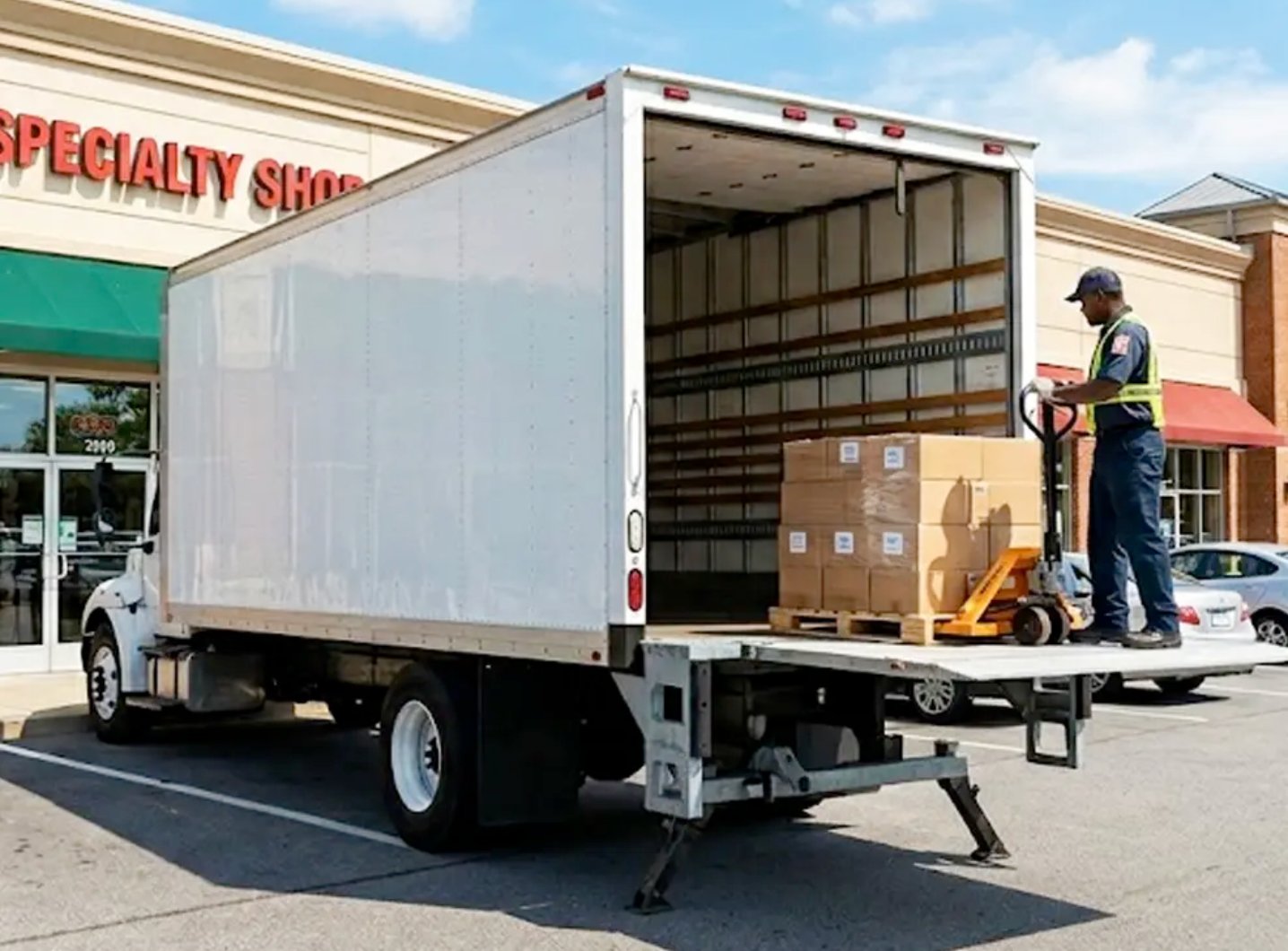
A liftgate is a hydraulic platform attached to the back of a truck. It can raise freight from ground level up to the trailer floor or lower freight from the trailer down to the ground.
For LTL shipments, a liftgate is commonly used when freight is:
- Palletized
- Too heavy to be moved by hand
- Delivered to a location without a loading dock
- Picked up from a small business, storage location, residence, or jobsite
- Delivered to a receiver without a forklift
A liftgate does not mean the driver will move freight deep inside a building. It usually means the driver can lower the freight from the truck to ground level or raise it from ground level to the truck. Inside delivery, long carry, driver assist, unpacking, or moving freight to a specific room may involve other services or charges.
Why liftgate fees are so common
Liftgate fees are common because many shippers and receivers do not think about loading conditions when requesting a freight quote. They may provide pickup address, delivery address, weight, dimensions, and pallet count — but forget to mention whether the pickup or delivery site has a dock or forklift. If the carrier arrives and the location cannot load or unload the freight without a liftgate, the shipment may need a liftgate truck, redelivery, or terminal coordination. That can lead to extra charges.
When is liftgate service needed?
Liftgate service is usually needed when freight must be moved between the trailer and ground level and the site does not have proper loading equipment. Common situations include:
- Delivery to a small retail store without a dock
- Delivery to an office building
- Delivery to a residential address
- Delivery to a school, church, farm, or small business
- Pickup from a storage unit or small warehouse
- Pickup from a location with no forklift
- Freight that is too heavy or large for manual unloading
- Palletized goods delivered to a site with ground-level receiving only
If the receiver has a dock or forklift, liftgate may not be needed. If the receiver does not have either, liftgate should be discussed before booking.
Liftgate has weight and size limits — it is not a solution for every shipment
Liftgate service is not unlimited. A liftgate truck can typically handle single pieces up to roughly 2,500 lbs and roughly 96 inches in length. Beyond those limits, a standard LTL liftgate truck may not be able to load or unload the freight safely, regardless of whether liftgate service is requested and paid for.
This matters for planning: if your shipment includes a piece heavier than about 2,500 lbs or longer than about 96 inches, you cannot rely on liftgate to solve a missing-dock problem. In that case, both the pickup and delivery locations need their own way to load and unload the freight — a dock, a forklift, or equivalent material handling equipment — because liftgate capacity will not cover it.
If you are not sure whether your heaviest or longest piece falls inside liftgate limits, mention the exact weight and dimensions before quoting rather than assuming liftgate will be available as a fallback.
Liftgate at pickup vs liftgate at delivery
Liftgate service can apply at pickup, delivery, or both.
Liftgate at pickup
Pickup liftgate may be needed if the shipper does not have a dock or forklift to load the freight onto the truck. For example, a small warehouse or business may have a pallet ready, but no forklift and no dock. The carrier may need to send a liftgate truck to load the pallet.
Liftgate at delivery
Delivery liftgate may be needed if the receiver cannot unload the freight from the truck. This is common for small businesses, offices, storage locations, residential addresses, and locations that only receive freight at ground level.
Both pickup and delivery conditions matter. A shipment can require liftgate at one end, both ends, or neither.
Why the quote may not include liftgate upfront
A liftgate fee may not appear on the original quote if the shipment was quoted as standard commercial dock-to-dock freight. This can happen when the quote request does not clearly state whether the pickup or delivery location has a dock or forklift, whether the freight is palletized, whether the receiver can unload it, or whether the site is residential, limited access, or a small business. If the carrier later discovers that liftgate is required, the final bill may be adjusted.
Liftgate vs loading dock vs forklift
These terms are related but different.
| Term | What it does |
|---|---|
| Loading dock | Raised platform the trailer backs up to, so freight moves directly between trailer and building |
| Forklift | Lifts freight from the ground, dock, or trailer depending on the site setup |
| Liftgate | Attached to the truck itself; moves freight between the truck and ground level |
If a location has a working loading dock or forklift, liftgate may not be needed. If it has neither, liftgate may be necessary for palletized freight — within the weight and size limits above.
Liftgate does not always include inside delivery
This is an important point. Liftgate service usually means the driver lowers the freight to ground level at the delivery location. It does not automatically mean the driver will move the freight inside the building, unpack it, bring it upstairs, or place it in a specific room. If the receiver needs freight moved inside, that may be considered inside delivery, driver assist, or another special service. Before booking, confirm exactly what the receiver expects the driver to do.
Can liftgate fees stack with other charges?
Yes. Liftgate can appear together with other accessorial charges, such as:
- Liftgate + residential delivery
- Liftgate + limited access
- Liftgate + appointment delivery
- Liftgate + redelivery
- Liftgate + inside delivery
- Liftgate + waiting time or detention
A common example is a pallet delivered to a small business without a dock. If the address is also in a restricted area or requires special receiving instructions, the bill may include both liftgate and limited access-related charges.
Real-world examples
Small business without a dock
A shipment is delivered to a small store with no dock and no forklift. The pallet cannot be safely unloaded by hand. The carrier needs a liftgate truck. If liftgate was not included in the original quote, a liftgate fee may be added.
Residential delivery
A customer orders palletized goods to a home address. The truck cannot back into a dock because there is no dock. The carrier may need residential delivery service and liftgate service.
Warehouse with forklift available
A warehouse has a forklift and staff ready to unload the truck, so liftgate may not be needed. However, if the forklift is unavailable when the truck arrives, the driver may need to wait, reschedule, or use additional services.
Pickup from a storage unit
A shipper has a pallet stored in a storage facility with no dock and no forklift onsite. A liftgate truck may be needed for pickup.
How to reduce surprise liftgate charges
Before requesting a quote, ask both pickup and delivery locations:
- Do you have a loading dock? Do you have a forklift?
- Can you load or unload palletized freight yourself?
- Is the freight on pallets? What is the heaviest piece?
- Can the truck access the receiving area?
- Is the site commercial, residential, or limited access?
- Does the driver need to bring the freight to ground level?
- Is inside delivery required? Are appointments required?
If there is no dock and no forklift, it is better to include liftgate in the quote upfront — and to flag it early if any single piece may be near or over the roughly 2,500 lb / 96 inch liftgate range.
What information should you send to ShipMay?
To help ShipMay quote LTL or truckload shipments more accurately, send:
- Pickup and delivery address, facility type
- Whether pickup and delivery each have a dock or forklift
- Pallet count, weight, dimensions, and heaviest piece weight
- Whether liftgate is needed at pickup or delivery
- Whether the site is residential or limited access
- Contact name and phone number, receiving hours or appointment requirements
The goal is to avoid quoting the shipment as a standard dock delivery when the actual site needs liftgate service.
Final takeaway
A liftgate fee applies when a carrier needs a liftgate truck to move freight between the trailer and ground level. It is common in LTL shipping because many small businesses, residential locations, storage facilities, and limited access sites do not have a loading dock or forklift. Liftgate is not necessarily a mistake or hidden fee — it is usually an extra service that should be identified before booking, and it has real capacity limits around 2,500 lbs and 96 inches per piece.
ShipMay helps importers, warehouses, freight forwarders, e-commerce sellers, and project cargo teams plan U.S. inland freight with fewer surprises — from drayage and transloading to LTL, truckload, intermodal, and final-mile delivery. Before quoting, confirm whether both pickup and delivery locations have a dock or forklift; if not, start a quote with ShipMay and tell us upfront so the service can be planned correctly.